





One of the most common questions from decorators and resellers getting started with DTF is how to price their work. You know what a DTF transfer costs to order, but turning that into a retail price that covers your time, materials, and overhead — while staying competitive — takes a bit more thought. Charge too little and you are working for nothing. Charge too much and customers walk.
This guide breaks down a practical pricing framework for DTF transfers and finished printed garments. Whether you are selling transfers wholesale to other decorators, pressing and selling finished shirts, or offering team uniform packages, the same core principles apply: know your cost, apply a consistent markup, and understand what the market will bear for your specific customer type.
Start with Your True Cost Per Transfer
Before you can set a selling price, you need to know exactly what each transfer costs you. This sounds obvious, but many decorators only count the transfer price and miss other real costs that eat into their margin.
Transfer Cost
The base cost is whatever you pay per transfer. This varies by size — a 4×4 inch transfer costs less than a 12×14 inch transfer. When you order through our DTF transfers by size and quantity page, the per-piece cost is listed clearly by size tier. Larger quantities within a size tier typically reduce the per-piece cost.
Gang Sheet Savings
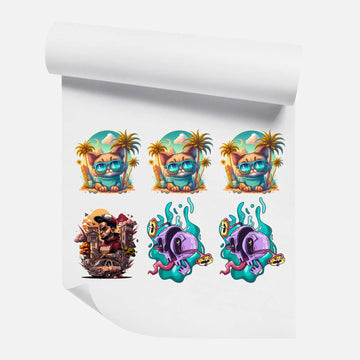
If you are not already using gang sheets, this is the single biggest lever for reducing your cost per transfer. A gang sheet lets you arrange multiple designs on one large sheet and pay for the sheet rather than for individual transfers. Small designs — left chest logos, hat transfers, sleeve prints — nest efficiently and can dramatically lower your per-design cost.
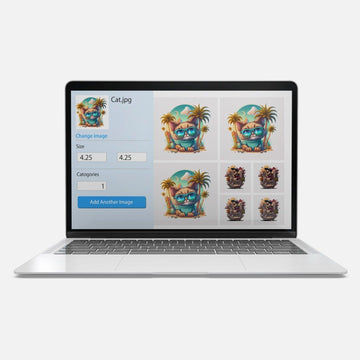
For example, a 22×60 inch gang sheet might hold 12 to 15 medium chest prints that would each cost significantly more if ordered individually. Use our DTF gang sheet online builder to fill sheets efficiently. The more efficiently you pack a sheet, the lower your effective cost per transfer.
Pressing Labor
Each transfer takes time to press — positioning, pressing, peeling, inspecting. A realistic estimate for a straightforward shirt press is 2 to 4 minutes per piece including setup time. At whatever your effective hourly rate is, that time has a cost. If you are paying an employee to press, this is a direct labor cost. If you are pressing yourself, it is your time and therefore an opportunity cost.
Many decorators starting out skip labor from their pricing calculation, then wonder why they feel busy but not profitable. Build it in from the start.
Garment Cost
If you are selling finished printed garments rather than just the transfers, the blank garment is part of your cost. A basic Gildan t-shirt runs $3 to $6 wholesale. A premium Next Level or Bella+Canvas tee is $7 to $12. A hoodie is $15 to $30 depending on brand and weight. Know your exact garment cost for each product in your lineup.
Overhead and Consumables
Heat press electricity, parchment paper, cover sheets, shipping materials, and a portion of your press depreciation all add up. For a simple estimate, add $0.25 to $0.75 per piece as a catch-all overhead figure. For higher-volume operations, track these costs more precisely.
Markup: How Much to Add
Once you know your true cost, the next step is applying a markup that builds in profit. Markup and margin are often confused — here is the distinction:
● Markup: The percentage added to your cost to arrive at the selling price. A 100% markup on a $5 cost gives a $10 selling price.
● Margin: The percentage of the selling price that is profit. A $10 selling price with a $5 cost = 50% margin.
Most apparel decorating businesses operate at 40% to 60% gross margin, which corresponds to a markup of roughly 67% to 150% on cost. The right markup for you depends on your market, your customer type, and your positioning.
Standard Retail Markup (Direct to Consumer)
If you are selling finished shirts directly to end customers — through your own store, at events, or via e-commerce — a 2x to 3x markup on total cost (transfer + garment + labor + overhead) is a reasonable starting point. On a shirt that costs you $12 all-in, a retail price of $24 to $36 is within normal range for custom printed apparel.
Wholesale / Bulk Markup
If you are selling to other businesses — boutiques, sports teams, corporate clients buying in quantity — your per-piece margin will typically be lower, but volume compensates. A 1.5x to 2x markup is common for wholesale pricing. The gang sheet efficiency from our ready-to-print DTF gang sheet option makes bulk orders more profitable by reducing your per-transfer cost as order size grows.
Transfer-Only Markup (Reselling Transfers)
Some decorators buy DTF transfers and resell them to other shops or to customers who press their own garments. In this model, you are adding a service margin on top of the transfer cost — sourcing, quality checking, and delivering ready-to-press transfers. A 30% to 60% markup on transfer cost is typical in the transfer resale market, though local competition and turnaround speed affect where in that range you land.
Pricing by Order Size
One of the practical realities of DTF pricing is that your cost per piece changes with order size — and your selling price should reflect that. Customers ordering in volume expect a better rate, and gang sheet efficiency actually does lower your cost, so passing some of that saving to the customer is reasonable.
Small Orders (1–11 pieces)
Single pieces and very small runs have the highest cost per transfer because you cannot fill a gang sheet efficiently. Your pricing should reflect this — do not discount small orders to match large-order pricing. A per-piece premium for small runs is standard practice and customers generally understand it. Minimum order charges are also common: many decorators set a flat minimum (e.g., $25 minimum per order) to keep small jobs profitable.
Medium Orders (12–48 pieces)
At this range, you can start filling gang sheets efficiently and your per-transfer cost drops meaningfully. This is where you can offer a moderate volume discount — typically 10% to 20% off small-run pricing — while still maintaining healthy margin. Many customers in this range are small businesses, teams, or event organizers who are price-sensitive but also ordering more regularly.
Large Orders (49+ pieces)
At this volume, gang sheet efficiency is maximized and your cost per transfer is at its lowest. This is also where you can offer your most competitive pricing without sacrificing margin. A sample pack sent to a prospect considering a large order is a good sales tool — once they see the quality in person, price conversations become easier.
Real Pricing Example: Custom T-Shirt Order
Here is how a simple pricing calculation looks for a 24-piece order of custom t-shirts with a front chest print:
● Blank t-shirt (Bella+Canvas 3001): $8.00 each
● DTF transfer (10×10 inch, ordered via gang sheet): $2.50 each
● Press labor (3 minutes at $20/hr effective rate): $1.00 each
● Overhead and consumables: $0.50 each
● Total cost per shirt: $12.00
At a 2.5x markup: $30.00 retail per shirt. For 24 shirts, that is $720 in revenue against $288 in cost — $432 gross profit, or a 60% gross margin.
The same calculation for a 6-piece order with individually ordered transfers (not gang sheet) might show a cost of $15 per shirt — which means pricing needs to go higher to maintain margin, or you accept lower margin on the small run knowing volume will pick up.
Pricing Add-Ons and Specialty Transfers
Standard DTF transfers are your baseline. Specialty transfers command higher prices and higher margins because customers are paying for something they cannot get from a standard print. Build separate pricing for:
● Glitter DTF transfers: Premium product, typically 30% to 50% higher than standard transfer pricing. Customers ordering glitter are usually less price-sensitive — they want the effect and are willing to pay for it.
● Glow in the dark DTF transfers: Similar premium to glitter. Event and novelty customers expect specialty pricing.
● Rush orders: If you offer same-day or next-day turnaround on pressing (beyond standard lead time), charge a rush premium — typically 20% to 40% on top of standard pricing. Our
● Multi-location prints: A shirt with a front chest print and a back print is two transfer applications, two press cycles, and more labor. Price each location separately rather than bundling at a flat rate.
What the Market Charges: Benchmarks
Knowing the market range helps you position competitively without underpricing. Based on common rates in the custom apparel industry:
● Single custom t-shirt (1 location print, standard DTF): $20 to $35 retail
● 12-piece order per shirt (1 location): $15 to $22 each
● 24-piece order per shirt (1 location): $12 to $18 each
● Custom hoodie (1 location DTF print): $35 to $60 retail
● DTF transfer only (4×4 inch, resale): $3 to $6 each
● DTF transfer only (10×12 inch, resale): $6 to $12 each
These are market benchmarks, not rules. Local competition, your positioning, your turnaround time, and your customer relationships all affect where your pricing lands. A shop known for fast turnaround and quality can price at the top of the range. A new shop building a customer base might price at the middle to attract initial orders.
Frequently Asked Questions
How much should I charge for a single custom DTF shirt?
For a single shirt with one print location, $25 to $35 is a typical retail price range. Your actual price depends on the garment cost, transfer size, and your local market. Single pieces have the highest cost per unit because you cannot spread gang sheet costs across multiple transfers, so do not price them at the same rate as bulk orders.
How do gang sheets affect my pricing?
Gang sheets lower your cost per transfer, which gives you two options: maintain your selling price and increase margin, or pass some of the saving to the customer to win more volume. For most businesses, the right answer is somewhere between the two — use gang sheet efficiency to improve margin on medium and large orders while staying competitive on price. The gang sheet builder makes it easy to see exactly how many designs fit on a sheet at your needed sizes.
Should I charge differently for specialty transfers like glitter or glow?
Yes. Specialty transfers cost more to produce and they deliver a result customers cannot get from standard printing. Price them at a premium — 30% to 60% above your standard DTF pricing is reasonable depending on the effect and your market. Customers choosing specialty options are typically less price-sensitive than those buying standard shirts.
What is a fair minimum order charge for DTF printing?
A minimum order charge of $25 to $50 per order is common in the custom apparel industry. It compensates for the fixed time cost of processing any order regardless of size — setup, communication, packing, and delivery. Without a minimum, very small orders (1 to 2 pieces) can actually cost more to handle than they generate in revenue. Set a minimum that makes every order worth taking.
Build a Pricing Structure That Works
Pricing DTF work does not need to be complicated, but it does need to be intentional. Know your cost per piece including labor and overhead. Apply a consistent markup that reflects your market position. Build in premiums for small runs, specialty transfers, and rush jobs. And review your pricing regularly as your costs and volume change.
If you are just getting started and want to understand your cost structure before setting prices, order a DTF transfer sample pack to test quality and get a feel for the process. When you are ready to build efficient orders that keep your cost per piece low, the gang sheet online builder is the right tool. And if you have specific questions about transfer sizing or order structure, our team is available through the contact page.


