




If you are building a custom apparel business — on Etsy, Shopify, Amazon, or through local sales — at some point you face the same decision every decorator faces: use a print-on-demand service like Printful or Printify, or buy DTF transfers and press shirts yourself. Both models work. They work very differently, and the right choice depends entirely on where your business is right now and where you want it to go.
This guide breaks down both models honestly — profit margins, print quality, fulfillment control, startup cost, and scalability — so you can make an informed decision rather than defaulting to whichever platform you discovered first.
How Print on Demand Works
Print-on-demand (POD) services like Printful, Printify, Gelato, and Gooten connect to your Etsy or Shopify store and fulfill orders on your behalf. When a customer places an order, the POD platform prints the shirt, packages it, and ships it directly to the customer — you never touch the product. You pay the platform a base price per item and keep the difference between that base price and your retail price.
The appeal is obvious: zero inventory, zero upfront cost, no equipment, no physical space required. List a design today and start selling tonight. The POD platform handles production, shipping, and returns. You focus on design and marketing.
The trade-off is margin. POD base prices are high relative to what the same shirt costs when you produce it yourself. A basic print-on-demand t-shirt from Printful typically runs $14 to $18 in base cost before you add your markup. To sell competitively on Etsy at $25 to $28, you keep $7 to $14 per shirt — and Etsy fees, transaction fees, and ad spend come out of that margin.
How DTF Transfers Work
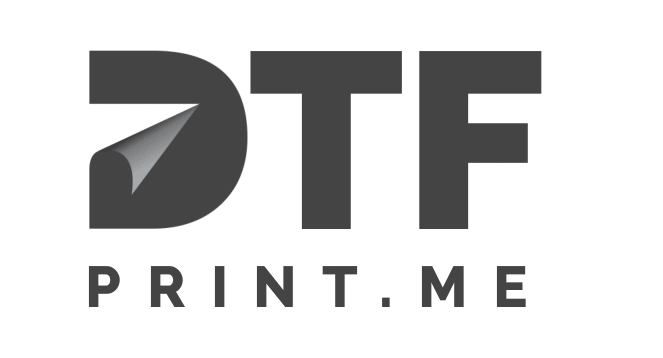
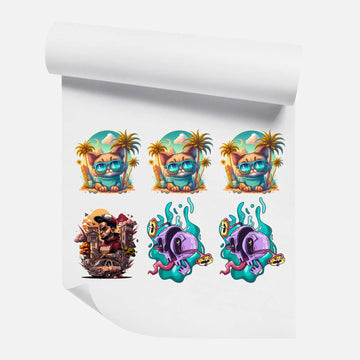
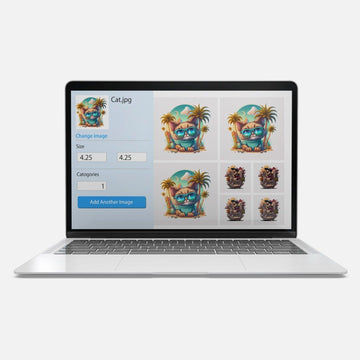
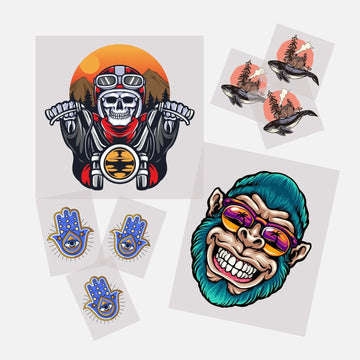
With DTF transfers, you buy print-ready transfers from a supplier — either individual transfers sized to your designs or tiled efficiently on a gang sheet — and press them onto blank shirts yourself using a heat press. You source your own blank shirts, handle your own packaging, and ship orders yourself or through a fulfillment partner.
The startup requirement is a heat press — an entry-level clamshell press runs $200 to $400, a quality swing-away press runs $400 to $800. Beyond the heat press, you need blank shirts, transfers, and packaging supplies. That is the full equipment list.
The upside is margin. A DTF transfer for a standard front design costs $1.50 to $3.50 depending on size and quantity. A blank shirt runs $3 to $6. Total product cost: $4.50 to $9.50 per shirt. Sell at $25 and you keep $15.50 to $20.50 — more than double what POD typically returns on the same sale price.
Profit Margin: The Core Difference
This is the number that matters most for anyone running a volume apparel business. Here is a realistic side-by-side on a $25 shirt sale:
Print on Demand (Printful example)
● Base cost (shirt + print): $14 to $18
● Etsy listing + transaction fee: ~$1.50
● Shipping pass-through (if not charging separately): $0 to $4
● Net margin per shirt: $5 to $9
DTF Transfers (self-fulfilled)
● Blank shirt cost: $3 to $6
● DTF transfer cost (gang sheet): $1.50 to $3.50
● Packaging supplies: ~$0.50
● Etsy listing + transaction fee: ~$1.50
● Net margin per shirt: $14 to $19
At 100 shirts per month, the DTF model generates roughly $500 to $1,000 more in profit than POD at the same price point. At 500 shirts per month, that gap becomes $2,500 to $5,000 in additional monthly margin. For any seller doing meaningful volume, the math on DTF is significantly better.
See our DTF pricing guide for a detailed breakdown of how transfer costs scale with order size and gang sheet layout.
Print Quality Comparison
Print quality is where the two models differ most visibly for end customers.
Print on Demand Quality
Most POD platforms use direct-to-garment (DTG) printing. DTG ink is water-based and bonds to fabric fibers, producing a soft print with good color on light fabrics. On dark fabrics, DTG requires a white underbase pretreatment that can feel slightly stiff and cracks faster than other methods with washing. DTG print quality varies by platform and by the specific printer and operator at the fulfillment center handling your order — consistency across orders can be hit or miss.
Some POD platforms also offer sublimation printing (polyester only) or screen printing at minimum quantities. Quality varies significantly across platforms and print methods.
DTF Transfer Quality
DTF transfers produce a print with a soft hand feel, vibrant color on both light and dark fabrics, sharp fine detail and small text, and consistent quality because you control the pressing process yourself. Every shirt you press is pressed by you under conditions you control — temperature, pressure, time. There are no fulfillment center variables.
DTF transfers on dark shirts include a white underbase that produces accurate, vivid color without the stiff, cracking pretreatment texture that DTG dark-shirt prints are known for. The finished DTF print is softer and more durable through washing than most DTG outputs at comparable price points. Our DTF dark shirts guide covers how DTF handles dark fabric printing in detail.
Turnaround Time
Print on Demand
POD turnaround is largely outside your control. Printful's standard production time is 2 to 7 business days depending on the product and current demand, plus shipping time. During peak periods — November, December, back-to-school — production times extend further. Customer-facing delivery windows of 7 to 14 days or longer are common. When something goes wrong — a misprint, a lost package, a quality issue — the resolution process runs through the POD platform and is slow.
DTF Transfers
With DTF transfers, your turnaround is split into two parts: transfer production time (2 to 3 business days from your supplier) and your pressing and shipping time. For orders placed on in-stock designs you already have transfers for, you can press and ship same-day or next-day. For new designs, the total production-to-shipment window is 4 to 6 business days — competitive with or faster than most POD services.
More importantly, you control the second half of that timeline. If an order is urgent, you press it first and ship it immediately. Customer service issues — wrong size, damaged in shipping — are handled directly by you with the ability to press a replacement shirt within hours.
Startup Cost and Barrier to Entry
Print on Demand
POD has essentially zero startup cost. Create an account, connect to your store, upload a design, and list. No equipment purchase required. This makes POD genuinely accessible to anyone — which is also why Etsy is saturated with POD shops selling nearly identical products at low margins.
DTF Transfers
DTF requires a heat press ($200 to $800) and a small initial inventory of blank shirts and supplies. Total startup cost to press your first production run is typically $300 to $1,000 depending on press quality and blank inventory. This cost is recovered quickly once you are doing volume — at 50 shirts per month with a $10 margin advantage over POD, the equipment pays for itself in 30 to 60 days.
The barrier to entry also works in your favor: competitors who do not want to invest in a heat press are stuck in POD with lower margins. Your willingness to operate a heat press is a competitive moat that most Etsy and Shopify competitors will not cross.
Inventory and Storage
Print on Demand
No inventory required — the POD platform holds all stock. You never touch a shirt. This is genuinely valuable for sellers with limited space or those testing designs before committing.
DTF Transfers
You hold blank shirt inventory and transfer inventory. Blank shirts are inexpensive and stack easily. DTF transfers store flat in a cool, dry space and last 12 to 24 months — you can order transfers in advance without worrying about them going bad. Our DTF storage guide covers proper transfer storage to maximize shelf life.
The inventory commitment for a small DTF operation is modest — 50 to 100 blank shirts across sizes and a stock of your most popular designs on transfer sheets. The key advantage of DTF over POD is that you can produce to order — press only what you sell rather than holding finished printed shirts.
Scalability
Scaling with Print on Demand
POD scales easily in the sense that you never have to do more physical work regardless of order volume — the platform handles everything. But margin compression gets worse as you scale because your cost per unit never decreases. 1,000 shirts per month on Printful costs the same per unit as 10 shirts per month. There is no volume discount. You are also entirely dependent on the POD platform's production capacity, reliability, and quality consistency — variables outside your control.
Scaling with DTF
DTF transfer cost drops as order volume increases — larger gang sheets and higher quantities reduce per-transfer cost significantly. At higher volumes, pressing efficiency also improves as you develop a rhythm. Beyond a certain volume, adding a second heat press or hiring a part-time presser to run alongside you extends capacity without a platform dependency.
For sellers reaching 200 or more shirts per month, the DTF model scales more profitably than POD because both margins and efficiency improve with volume. At very high volume, some sellers add additional heat presses or explore bringing a DTF printer in-house — but for most small and mid-size custom apparel businesses, buying DTF transfers from a supplier and pressing in-house hits the right balance of quality, margin, and capital efficiency.
When Print on Demand Makes Sense
POD is the right choice in specific situations: when you are testing a design concept with zero capital risk before investing in a press and blank inventory; when you need to list a product immediately with no lead time; when your volume is very low (under 20 to 30 shirts per month) and the equipment investment is not yet justified; or when you are selling a product category the POD platform offers that you cannot easily produce with a heat press.
POD also makes sense as a complement to DTF — using a POD service for products outside your core production capability (all-over print shirts, cut-and-sew items) while using DTF for your standard apparel line.
When DTF Transfers Win
DTF transfers are the better model for anyone doing meaningful volume, prioritizing profit margin, wanting control over product quality, or building a custom apparel brand with repeat customers. The margin advantage compounds over time. The quality control advantage reduces customer service issues. The turnaround flexibility advantage lets you serve urgent orders that POD cannot handle.
For Etsy and Shopify sellers doing 50 or more shirts per month, switching from POD to DTF transfers typically doubles or triples net monthly profit on the same sales revenue. That difference — earned back in 30 to 60 days of sales after recovering the heat press cost — is the reason experienced custom apparel sellers consistently move away from POD as their businesses grow.
If you are ready to test the DTF model, start with a DTF transfer sample pack to evaluate quality before ordering for your full product line. When you are ready to build your transfer inventory, the gang sheet builder gives you the most cost-efficient path to stocking your designs at production-ready scale.
Frequently Asked Questions
Is DTF printing better than Printful?
For profit margin and print quality, DTF transfers pressed in-house outperform Printful and most POD services. Printful's base cost per shirt is significantly higher than the combined cost of a DTF transfer plus a blank shirt. DTF also gives you direct control over quality, turnaround, and customer service. Printful wins on zero startup cost and no physical work — which matters most for very early-stage sellers testing concepts.
How much more profit do you make with DTF vs print on demand?
On a $25 shirt, DTF self-fulfillment typically nets $14 to $19 per shirt. Print on demand on the same shirt typically nets $5 to $9. At 100 shirts per month, the DTF model generates $500 to $1,000 more in monthly profit. The gap widens as volume increases because DTF transfer costs drop with quantity while POD costs stay flat.
Do I need a heat press to use DTF transfers?
Yes. DTF transfers require a heat press to apply correctly — consistent temperature (300 to 315°F), even pressure, and controlled press time. A household iron does not deliver the consistency needed for production-quality results. Entry-level clamshell heat presses start around $200 to $300 and are sufficient for small-volume production.
Can I use DTF transfers for an Etsy shop?
Yes — and many successful Etsy custom apparel sellers use DTF transfers as their primary production method. The workflow is straightforward: take orders, press transfers onto blanks, ship within your stated processing time. DTF turnaround is fast enough to compete with POD shipping windows while delivering better margins and consistent quality. Our DTF Etsy sellers guide covers the full workflow for running an Etsy apparel shop with DTF transfers.


