


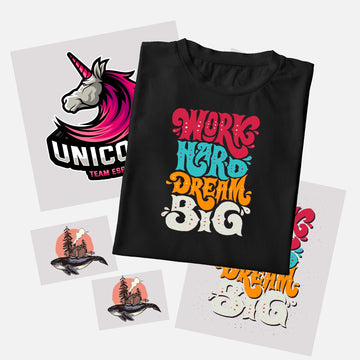


Starting a custom t-shirt business used to require screen printing equipment, a large minimum order, or a print-on-demand platform that takes most of your margin. DTF transfers changed that equation. With DTF, you can order professional-quality custom transfers, press them onto blank shirts yourself, and sell finished product — with no printing equipment, no dye, no screens, and no large upfront inventory commitment.
This guide covers everything you need to get a custom apparel business running with DTF transfers — from your first order through pricing, platforms, and scaling when demand grows.
Why DTF Makes Sense for a New Custom Apparel Business
DTF (Direct-to-Film) printing produces a full-color transfer that bonds to fabric through a heat press. The result is soft, durable, vibrant — competitive with screen printing on quality and far more flexible on minimum order size. For someone starting a custom apparel business, DTF transfers solve the three biggest barriers to entry:
● No printing equipment needed: You order finished transfers and press them yourself. A quality heat press costs $200 to $500 — far less than screen printing or DTF printing equipment, which runs into thousands.
● No minimums that force inventory risk: DTF transfers are available in small quantities. You can order one transfer to test a design, then order in bulk as demand confirms it.
● No color limitations: Screen printing charges per color. DTF prints full color — photographs, gradients, fine detail — at the same price as a simple design. Your creative range is unlimited.
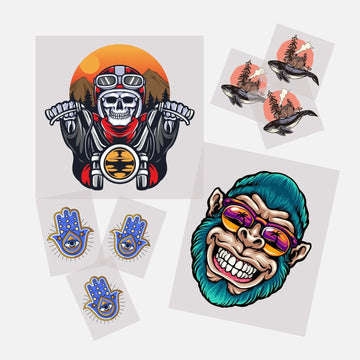
The model works like this: you create designs, order DTF transfers from a print provider like dtfprint.me, press those transfers onto blank garments you source separately, and sell the finished shirts at retail. Your profit is the spread between your total cost (transfer + blank + labor) and your retail price.
Step 1 — Define Your Niche
The most common mistake new custom apparel businesses make is trying to sell to everyone. A shop that sells "any custom shirt" competes with every other custom printer in the country. A shop that specializes in a specific niche — youth baseball teams, small-town pride apparel, funny nursing shirts, dog breed tees — has a defined audience, can build a recognizable brand, and earns customer loyalty in a way that generic shops cannot.
Good niche criteria: you have direct access to the audience (you coach youth sports, you are in a specific industry, you are part of a community), or you can reach the audience cheaply through social media or search, and the audience has demonstrated willingness to spend on branded apparel.
Some niches that work well with DTF transfers specifically: sports teams and youth leagues (seasonal orders, bulk potential), local community and city pride apparel, occupation-specific humor (nurses, teachers, electricians), pet breeds, and custom event merchandise (reunions, tournaments, fundraisers). You are not locked into one niche forever — start focused and expand once you have revenue and reviews.
Step 2 — Set Up Your Heat Press
You need a heat press to apply DTF transfers to garments. This is the only significant equipment investment required to run a DTF-based apparel business. Heat presses range from entry-level swing-arm models at $150 to $300 to professional clamshell or auto-open presses at $400 to $800.
For starting out, a 15 x 15 inch clamshell heat press in the $200 to $400 range is sufficient. This size handles standard shirt placement (chest print, back print, pocket print) for adult and youth sizes. Look for a press with digital temperature and time controls — analog dials are harder to set accurately and consistency matters for clean transfers.
DTF transfers from dtfprint.me apply at 300 to 320°F for 10 to 15 seconds with medium pressure, then peel hot or warm depending on the transfer type. See our DTF heat press settings guide for detailed temperature, time, and pressure settings by fabric type. Consistent settings produce consistent results — set your press and let it fully preheat before your first shirt.
Step 3 — Source Your Blank Garments
Your blank garments are your canvas. Quality matters — a great transfer on a low-quality shirt produces a product customers will not repurchase. The most popular blanks for custom apparel businesses are Bella+Canvas 3001, Next Level 3600, Gildan 64000, and Comfort Colors 1717. Each has a different weight, fit, and feel profile.
Bella+Canvas 3001 and Next Level 3600 are the most popular premium choices — retail-fit, soft, well-constructed. Comfort Colors 1717 has a garment-dyed vintage look that is currently very popular with certain audiences. Gildan 64000 is more affordable and works well for event shirts and bulk orders where cost matters more than retail-feel.
Source blanks from wholesale distributors — S&S Activewear, SanMar, and Alpha Broder are the three largest. Wholesale pricing at these distributors is significantly lower than retail. You will need a business license or resale certificate to open a wholesale account in most cases, which is a straightforward process once you have a registered business entity.
Step 4 — Design Your First Products
Your designs are what you are actually selling. Customers are not buying a t-shirt — they are buying the expression, the humor, the identity that the design carries. Invest real time and attention here.
You do not need to be a graphic designer. Canva has a free tier with templates you can adapt. Adobe Illustrator (subscription) and Affinity Designer (one-time purchase) give you full professional control. Fiverr and Upwork have affordable graphic designers who specialize in t-shirt artwork if you want to outsource.
For DTF transfers, provide your artwork as a high-resolution PNG with a transparent background, at 300 DPI minimum at the intended print size. A design that will print 12 inches wide needs to be at least 3,600 pixels wide. See our DTF artwork preparation guide for full file specifications — submitting correctly prepared artwork prevents delays and ensures the print matches your design intent.
Start with 3 to 5 designs. Test them with a small transfer order before committing to larger quantities. Market feedback will tell you quickly which designs resonate and which do not.
Step 5 — Order DTF Transfers
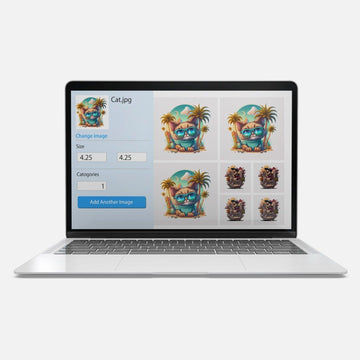
Once your artwork is ready, order your transfers. At dtfprint.me, you can order transfers by size and quantity — a per-transfer approach that works well for testing new designs or filling individual orders as they come in. For designs you know will sell in volume, ordering gang sheets is the most cost-effective approach.
Understanding Gang Sheets
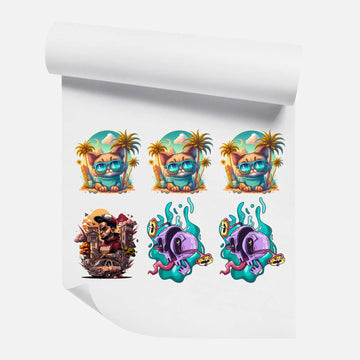
A gang sheet is a single large print sheet — typically 22 x 60 inches or similar — packed with multiple copies of your design (or multiple different designs). Because the sheet is printed as one unit, the per-transfer cost drops dramatically compared to ordering individual transfers. A gang sheet packed with 20 copies of a design costs significantly less per transfer than ordering 20 individual transfers.
Gang sheets make sense once you know a design will sell. For a design you have validated through early sales, switching from individual transfers to gang sheets immediately improves your margin. See our gang sheet guide for how to pack a gang sheet efficiently and what file specifications to submit.
Step 6 — Price Your Products
Pricing is where many new apparel businesses undercharge and leave margin on the table — or overcharge and kill conversion. Here is a simple framework:
● Cost of goods: blank garment cost + transfer cost + any packaging. For a premium blank at wholesale ($4 to $7) plus a standard chest transfer ($2 to $4 depending on size and quantity), your cost of goods typically runs $6 to $12 per shirt depending on quality tier and order volume.
● Labor: your time to press, fold, package, and ship each order. At first this is your time. Factor in at least $1 to $3 per shirt for small operations.
● Platform and transaction fees: Etsy charges listing fees and takes roughly 6.5% of the sale price plus payment processing. Shopify charges a monthly fee plus payment processing. Selling at local markets has no percentage cut but has booth fees.
● Target margin: For a retail custom apparel business, a 50% to 65% gross margin is a healthy target. That means if your total cost is $10 per shirt, pricing at $24 to $28 retail gives you the margin to absorb platform fees, the occasional return, and still generate profit.
Do not price based on what you think customers will pay — price based on your costs and required margin, then validate whether the market accepts that price. If demand is strong at your price, you are priced correctly. If conversion is low, test a lower price point or reassess your cost structure before dropping price as a first response.
Step 7 — Choose Where to Sell
Etsy
Etsy is the most natural starting platform for custom apparel. The platform has built-in search traffic from buyers actively looking for custom and personalized products. Setup is simple, listing costs are low ($0.20 per listing), and the platform handles payment processing. The tradeoff is that Etsy takes 6.5% of each sale plus payment processing, and you are competing with every other custom apparel seller on the platform. Strong product photography and consistent 5-star reviews determine visibility in Etsy search.
Your Own Shopify Store
A Shopify store gives you full control over your brand, your customer data, and your margins — with no per-sale percentage to a marketplace. The tradeoff is that you are responsible for driving your own traffic through social media, email, SEO, and paid ads. Shopify makes sense once you have validated that your products sell and you are ready to invest in marketing your own storefront. Running Etsy and Shopify simultaneously is a common strategy — Etsy drives discovery, your own store captures repeat customers at better margins.
Local Markets and Events
Farmers markets, craft fairs, pop-up shops, and local events give you direct customer interaction and immediate cash flow. No shipping, no platform fees, and instant feedback on which designs attract attention. Local markets are an excellent starting point for testing product-market fit before investing in an online store. They also build local brand recognition that drives word-of-mouth referrals.
Direct Outreach to Teams and Organizations
Youth sports leagues, school organizations, churches, and local businesses all need custom apparel regularly. Direct outreach to coaches, team managers, and organization leaders bypasses marketplace competition entirely. A single relationship with a youth sports league can produce multiple bulk orders per season. This model has lower margin per shirt but higher volume per transaction and more predictable revenue.
Step 8 — Photograph Your Products
Product photography is the single biggest lever on conversion in a custom apparel business. Customers cannot touch or try on your shirts — they are making a purchase decision based entirely on what they see on screen. Blurry photos, bad lighting, or shirts photographed flat on a table cost you sales.
You do not need a professional photographer to start. A smartphone with good natural light and a neutral background produces acceptable product photos. Flat lay photos (shirt laid flat on a clean surface, shot from directly above) are easy to produce and perform well on Etsy and social media. On-model photos — shirts worn by a person — outperform flat lays for most audiences because they show fit and scale. Ask a friend or family member to model, or use a mannequin for consistency.
For mockups used in listings before you have physical product, Placeit and Printful offer mockup generators where you upload your design and it renders on a real photographed shirt. These are acceptable for initial listings but should be replaced with real product photos as soon as possible.
Step 9 — Manage Orders and Scale
At low order volume, you fulfill orders yourself — press, package, ship. As volume grows, this becomes a time constraint. The natural scaling options for a DTF-based apparel business are:
● Batch production: Press all shirts for a design at once rather than one at a time. A heat press cycle takes 15 to 20 seconds. Pressing 20 shirts in a batch takes under 10 minutes of active press time versus managing 20 separate order fulfillment sessions.
● Pre-pressed inventory: For proven bestselling designs, maintain pre-pressed inventory in common sizes. Incoming orders ship same-day without a press cycle at the time of order.
● Second heat press: When your press is the bottleneck, a second press doubles throughput without adding floor space or significant capital.
● Outsourced fulfillment: At higher volume, order fulfillment services can handle pick, pack, and ship from their warehouse. This requires inventory pre-shipped to the fulfillment center.
The advantage of DTF transfers is that they scale well in either direction — low volume individual orders and high volume bulk production use the same process and the same equipment. You are not locked into a model that only works above a certain volume threshold.
What DTF Cannot Do Well
DTF transfers are excellent for most custom apparel applications, but there are situations where they are not the right tool. Very large prints — a full back print over 13 x 17 inches — require a larger transfer and more careful pressing to ensure even adhesion across the full surface. DTF on performance moisture-wicking polyester (the kind used in athletic jerseys) requires specific heat and pressure settings and a soft-hand finish to avoid stiffness — see our guide to DTF on nylon and synthetic fabrics for specifics.
For orders of 50 or more identical shirts in limited colors, screen printing may become price-competitive with DTF at scale. For apparel that needs an embroidered or tactile element rather than a printed graphic, DTF versus embroidery covers the decision factors. Know the limitations so you can set accurate expectations with customers.
Frequently Asked Questions
How much does it cost to start a custom t-shirt business with DTF?
The minimum startup cost is a heat press ($200 to $500), blank garments ($4 to $10 per shirt wholesale), and DTF transfers ($2 to $5 per transfer for small orders). For a true first run — 10 shirts with 10 transfers and basic supplies — you can be operational for under $400 to $600 in equipment and $60 to $100 in product cost. This is substantially less than screen printing or embroidery equipment setups.
Do I need a business license to order DTF transfers?
No — you can order DTF transfers without a business license. A business license becomes necessary if you want to open a wholesale account with blank garment distributors (for lower cost blanks) or if you are required to collect sales tax in your state as a seller. Consult a local accountant or your state's Secretary of State website for the registration requirements in your area.
How many shirts can I press per hour?
With a standard heat press and organized workflow, a single operator can press 40 to 80 shirts per hour for a straightforward chest print — 15 to 20 seconds of press time per shirt plus positioning and removal time. Batch workflow (pre-position all blanks, press sequentially) is faster than handling each shirt individually. At this rate, 100 shirts is a 90-minute to 2.5-hour production session.
Can I sell on Etsy and my own website at the same time?
Yes — running Etsy and your own Shopify store simultaneously is a common and effective strategy. Etsy drives discovery traffic for new customers. Your own store captures repeat buyers at lower fees and lets you build a direct customer relationship through email marketing. Keep product listings consistent across both platforms and fulfill from the same inventory.
Get Started with DTF Transfers
dtfprint.me supplies DTF transfers to custom apparel businesses throughout the Atlanta area and nationwide — individual transfers for small orders, gang sheets for volume production, fast turnaround. Order by size and quantity at dtfprint.me/products/transfer-by-size-qty or contact us through the contact page with questions about gang sheets, file preparation, or volume pricing.


